Why is my drone not turning on after a crash
A drone that won't power on after a crash usually has a tripped battery, a cracked power board, or a broken solder joint. Here's how Houston pilots diagnose and fix it.
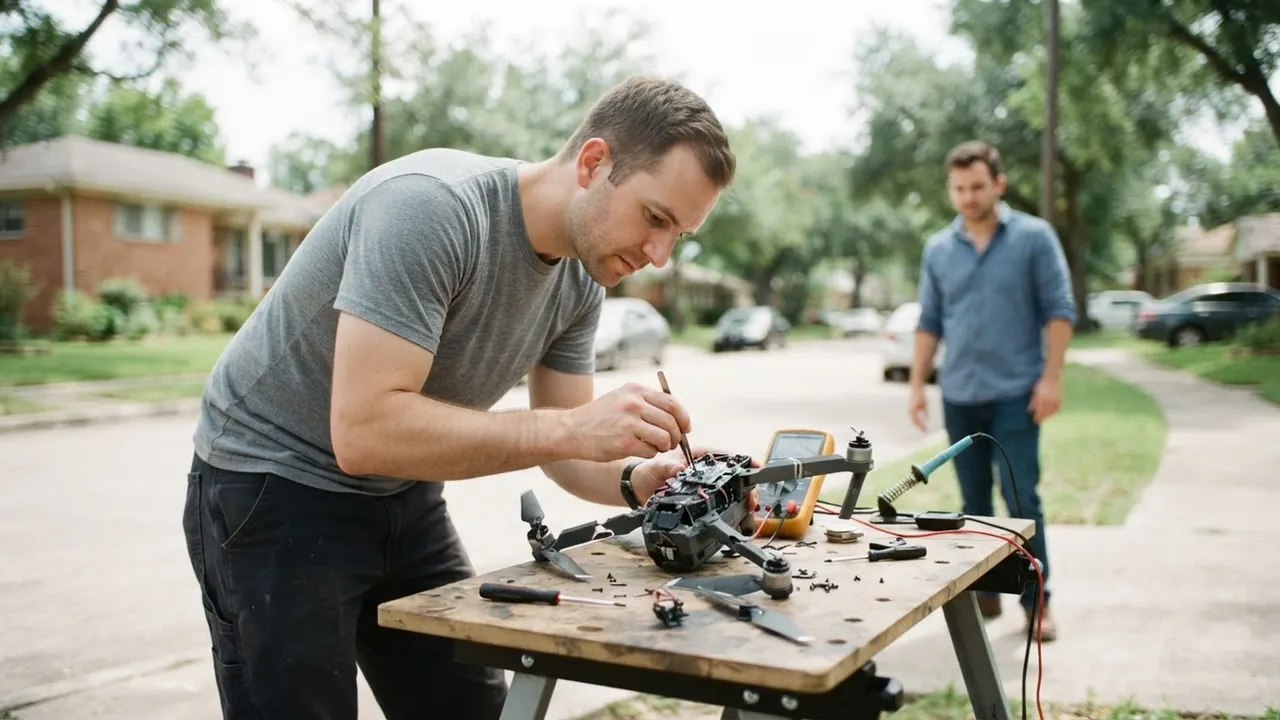
A drone that won't turn on after a crash is almost always suffering from one of three things: a battery that has tripped its internal protection circuit, a cracked power distribution board, or a broken solder joint where the battery leads meet the mainboard. The crash itself rarely kills the whole aircraft - it kills the weakest electrical connection in the chain, and the drone goes completely dead as a result. If you're searching for drone not turning on after crash Houston TX, the good news is that most of these failures are repairable for a fraction of the cost of a new aircraft. Below we walk through the exact causes, what you can safely check at home, what mistakes make it worse, and what 2026 repair pricing looks like in Houston.
The short answer: why a crashed drone goes dead
Drone not turning on after crash Houston TX is a power-delivery failure, not usually a total electronics failure. When a drone hits the ground, the impact sends a shock through the frame that travels further than you'd expect. The battery can shift a few millimeters in its bay, the power leads can stretch, and the mainboard can flex just enough to crack a solder pad that was already marginal from the factory.
Think of it like a car that won't start after a fender bender. The engine is fine. The battery cable popped off the terminal. In a drone, the equivalent is a battery management circuit that has latched into protection mode, or a power lead that has separated from the board. The motors, camera, and flight controller are often perfectly healthy - they just aren't getting electricity.
That's why the first diagnostic step is never "replace the drone." It's finding where the power stops. Our team does that every week at our bench, and the answer is usually visible within the first ten minutes of teardown.
The five most common causes we see in Houston
Houston's heat and humidity change what fails first. A drone that crashes in Phoenix behaves differently than one that crashes in Houston, because the electronics here have already been cycling through 95°F afternoons and 80% humidity for months before the impact.
1. Battery protection circuit has tripped
Most modern smart batteries have a built-in BMS (battery management system) that cuts output if it detects a short, a voltage spike, or a cell imbalance. A hard crash can trigger that protection even when the cells are healthy. The drone shows no lights, no beep, nothing - because the battery is deliberately refusing to send power. A bench reset or a Drone battery replacement Houston TX solves this in most cases.
2. Cracked power distribution board
The PDB sits at the center of the frame and takes the full force of a nose-in crash. Hairline cracks in the copper traces are common and often invisible to the eye. The board looks fine, the multimeter says otherwise. This is one of the top reasons a drone won't boot up after a hard landing.
3. Broken solder joint on the battery leads
Where the battery pigtail meets the mainboard, the solder pads are small and the wires are stiff. A crash that yanks the battery sideways can crack that joint without tearing the wire. You'll see the insulation intact and assume it's fine. It isn't.
4. Blown power MOSFET or fuse
Some drones use a sacrificial fuse or a power MOSFET that dies to protect the rest of the board. That's actually good design - a $4 component fails so a $200 board survives. Replacing it is a soldering job, not a parts-cannon job.
5. Water exposure after the crash
If your drone went down in a Houston bayou, a flooded ditch, or even wet grass after a rainstorm, corrosion starts within hours. A drone that won't turn on the next morning after a wet crash needs Drone water damage repair Houston TX before you try to power it again. Powering a wet board is how a $150 repair becomes a $400 one.
What to check before you bring it in
You can safely rule out about half of the possible causes at your kitchen table. Do these in order and stop the moment something looks wrong.
- Try a known-good battery. If you have a second battery that you know charges and flies, swap it in. If the drone powers up, the problem is the original battery - not the drone.
- Check the battery terminals. Look for black scorching, green corrosion, or bent pins. Scorching means the battery has been arcing and needs to be retired, not recharged.
- Inspect the frame around the battery bay. A cracked frame can let the battery sit loose enough that it never makes solid contact. That's a Drone frame repair Houston TX issue, not an electronics issue.
- Listen for any sound at all. A faint click or a single LED flash means the board is alive and the problem is downstream. Total silence points to the battery or the main power path.
- Do not open the shell if the drone is under warranty. Once you break the seal, you own the repair.
If none of those steps bring it back, the drone needs bench diagnostics. Guessing from here costs more than diagnosing.
Common mistakes that turn a repair into a replacement
The single most expensive mistake we see is repeated power-on attempts. Every time you press that button on a crashed drone, you're sending current through a circuit that may be shorted. That's how a $90 power board repair becomes a $300 mainboard replacement.
Other mistakes that show up on our bench:
- Charging a battery that was in the crash. A physically damaged LiPo can vent or catch fire during charge. If the pack is dented, puffy, or smells sweet, retire it.
- Straightening bent arms by hand. Carbon fiber and aluminum arms crack internally when you bend them back. You'll fly once and lose the drone again.
- Spraying contact cleaner into the electronics. Most contact cleaners leave a residue that attracts Houston humidity and accelerates corrosion.
- Assuming the gimbal is dead because the drone is dead. The gimbal gets power from the mainboard. Fix the power path and the gimbal often comes back on its own. If it doesn't, that's a separate Drone gimbal repair Houston TX job.
- Buying parts before diagnosing. We see customers arrive with a new mainboard they didn't need. The actual fault was a $12 power lead.
How much does drone crash repair cost in Houston TX in 2026?
Typical 2026 pricing in the Houston area for a drone that won't turn on after a crash runs from about $85 for a battery or power-lead fix up to $450 for a full mainboard replacement on a prosumer airframe. Most jobs land in the $120-$260 range.
Here's how the numbers break down by fault type:
- Battery reset or replacement: $85-$180 depending on cell count and smart-battery electronics.
- Power lead or solder joint repair: $95-$160, usually same-day.
- Power distribution board replacement: $140-$240 including parts.
- Mainboard replacement: $280-$450, and it requires pairing and calibration afterward.
- Water damage recovery: $150-$350 depending on how long the board sat wet.
Diagnostics typically run $45-$75 and get credited toward the repair if you approve the work. That's the honest way to price it - you shouldn't pay full diagnostic and full repair for the same fault.
For comparison, replacing a mid-range consumer drone runs $700-$1,200, and replacing a prosumer airframe with a comparable camera runs $1,500-$3,000. Repair wins on price in almost every case where the camera and gimbal survived.
When to call a professional
Call a professional the moment you've swapped in a known-good battery and the drone still won't power on. That single test separates a user-fixable problem from a bench problem, and it takes two minutes.
You should also bring it in if any of these are true:
- The drone was submerged or rained on.
- You smell burnt electronics or see scorch marks.
- The battery is puffy, dented, or warm to the touch when it shouldn't be.
- The frame is visibly cracked near the battery bay or motor mounts.
- The drone is a commercial unit used for inspections, mapping, or thermal work - downtime costs more than the repair.
Our technicians handle crash diagnostics daily, from DJI Mavic and Air series to Autel EVO, Skydio, and custom-built inspection rigs. We test the power path first, then the board, then the peripherals, so you get a straight answer instead of a parts list. If you fly commercially around the Port of Houston or the Energy Corridor, we also offer Drone maintenance services Houston TX to catch the small stuff before it grounds your fleet.
Frequently Asked Questions
Why is my drone not turning on after a crash in Houston TX?
The crash has interrupted power between the battery and the mainboard. In about 70% of the cases we see, it's a tripped battery protection circuit, a broken power lead, or a cracked power distribution board. The motors and camera are usually fine.
What should I do if my drone won't turn on after a crash in Houston Texas?
Stop pressing the power button. Swap in a known-good battery and try once. If it still won't boot, unplug the battery, bag the drone, and bring it in for diagnostics. Repeated power-on attempts on a shorted board cause more damage than the crash did.
Where can I repair a drone that won't turn on in Houston TX?
Bring it to a shop that does board-level diagnostics, not just part swapping. We test the battery, power leads, PDB, and mainboard in sequence, and we tell you which one failed before we quote the repair. Most Houston-area diagnostics are done same day.
How much does drone crash repair cost in Houston TX?
In 2026, most crash-related no-power repairs in Houston run $120-$260. Battery and power-lead fixes sit at the low end, around $85-$160. Mainboard replacements push toward $280-$450. Diagnostics are $45-$75 and credited toward the repair.
Can I fix a drone that won't turn on myself in Houston TX?
You can safely swap batteries, inspect terminals, and check for a cracked frame. Anything past that - soldering, board-level testing, MOSFET replacement - needs a bench and a multimeter. Attempting it without those tools usually costs more than the original repair would have.
Get help with Drone repair in Houston
If your drone went down and won't come back on, don't keep pressing the button. Bring it to Drone repair Houston TX and we'll find the fault, tell you what it costs, and get you flying again - usually within a couple of days.
Call us at +1 281 555 4468 to schedule diagnostics or ask whether your model is one we service.