Gimbal arm bent after a hard landing
We straighten or replace the gimbal arm, swap the ribbon cable if it is torn, and recalibrate all axes on a gimbal calibration tool. A test flight confirms level horizon and smooth response before handoff.
When a payload quits mid-job, every flight hour you lose is money. Our Drone payload repair Houston TX service rebuilds gimbals, LiDAR units, thermal cameras, and spray systems for DJI, Autel Robotics, and Skydio platforms. We have worked on Houston airframes since 2018, and we diagnose most payload faults the same day you drop off. Bring us the aircraft, the controller, and the battery, and we will tell you exactly what failed and what it costs to fix.
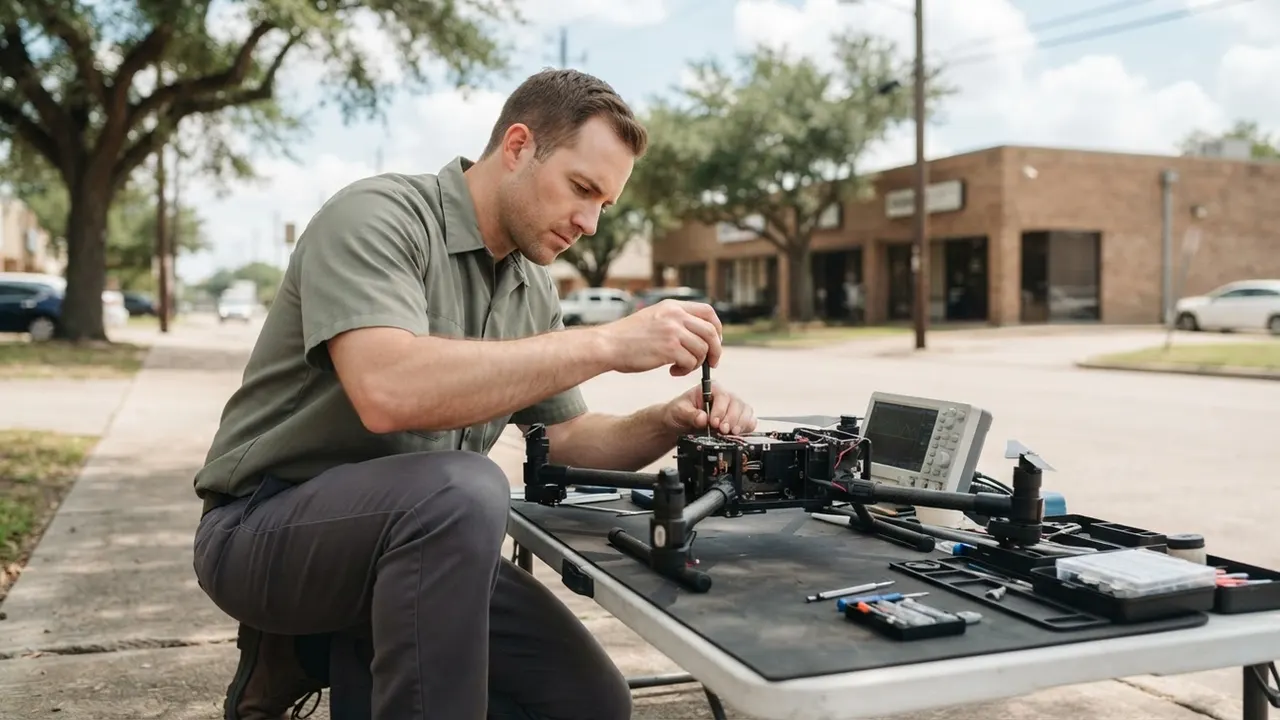
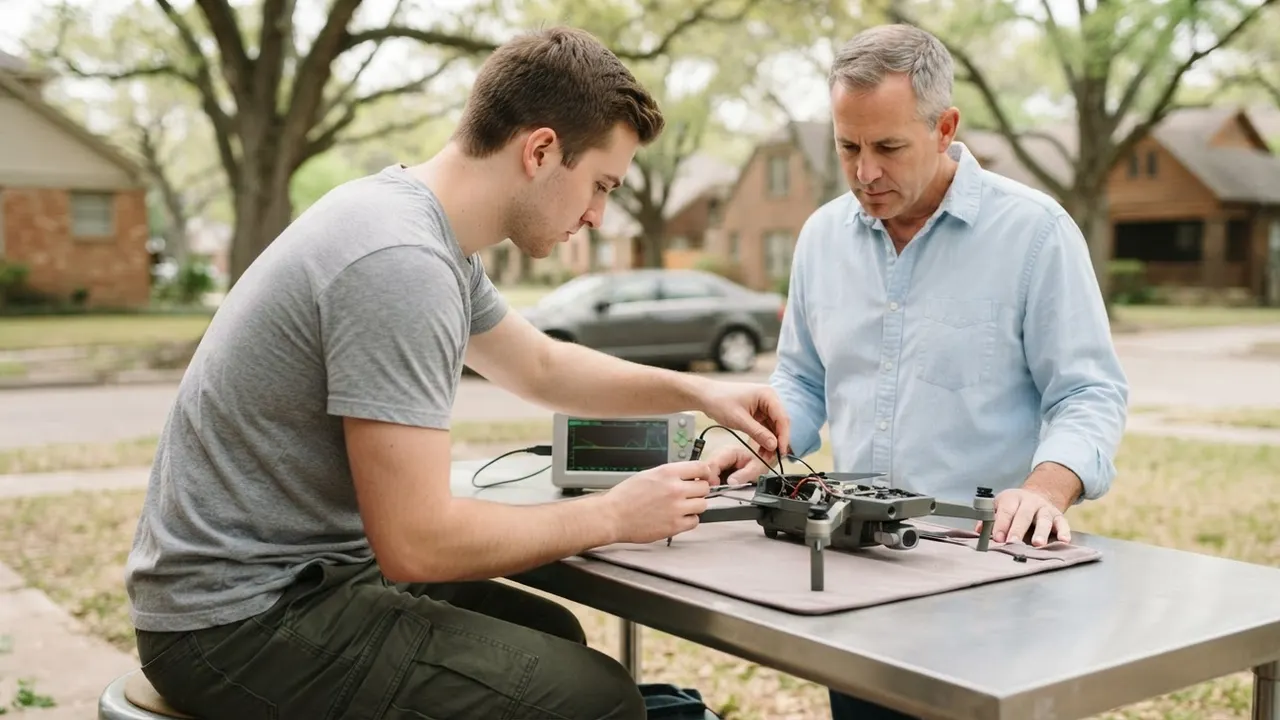
Drone payload repair Houston TX is the bench-level diagnosis and rebuild of everything a drone carries below the airframe: gimbals, camera modules, LiDAR scanners, thermal sensors, spray tanks, and release mechanisms. We start with a full diagnostic on a multimeter and oscilloscope, checking bus voltage, signal continuity, and motor torque on the gimbal axes. From there we replace damaged ribbon cables, reseat connectors, swap out brushless motors, and recalibrate the IMU on a level stand. Most payload jobs finish in two to five days, and we test-fly every aircraft before it goes back to you.
Houston operators put payloads through real punishment. Summer heat pushes gimbal motors and LiPo batteries past 100 degrees on the pad, and Gulf humidity corrodes exposed connectors on agricultural rigs. We see crash damage from tree lines in Memorial, water damage from bayou flights near Clear Lake, and firmware issues after a botched update. If you need a drone payload service Houston pilots trust for DJI Agras sprayers or Matrice thermal rigs, our shop handles the whole repair under one roof and documents every part we touch.
Every payload job starts with a full diagnostic and ends with a test flight. What sits in between depends on what failed, but the core coverage below is standard on all repairs. Parts are quoted separately and approved by you before we open the airframe.
We read fault codes, test bus voltage with a multimeter, and trace signal on an oscilloscope. Gimbal motors get a torque check and cameras get a live feed test. You receive a written report naming the failed component and the repair path.
Bent arms, dead roll motors, torn ribbon cables, and cracked lenses are all handled on the bench. We stock gimbal motors and cables for common DJI and Autel airframes, and we replace camera modules when repair is not viable.
IMU calibration on a level stand, compass calibration away from steel, and a gimbal calibration tool pass are included. LiDAR and thermal payloads get accuracy verification against a known reference before handoff.
We hover-test every repaired aircraft and check gimbal response, sensor output, and signal integrity. If the payload does not perform in the air, it does not leave the shop. Flight logs are available on request.
Our work is warrantied. If the same fault returns, bring the aircraft back and we make it right. We document every part we replace so there is no question about what was done and when.
You bring the aircraft, controller, and battery to our bench. We photograph the airframe from six angles and log the serial number, firmware version, and any error codes on the controller screen. This takes about 20 minutes and gives us a baseline if the damage is disputed later.
We power the payload on a bench supply and read bus voltage with a multimeter, then trace signal on an oscilloscope. Gimbal motors get a torque check, and camera modules get a live feed test. Most faults show up within 45 minutes, and we call you with findings the same day.
Once you approve the quote, we pull the payload and replace what failed. That might be a ribbon cable, a gimbal motor, a camera module, or a landing gear mount. We use a hex driver set and soldering station for board-level work, and we only fit parts that match the original spec.
Every repaired payload gets an IMU calibration on a level stand, a compass calibration away from steel, and a gimbal calibration tool pass. Then we fly it. Hover stability, gimbal response, and sensor output all get checked in the air before we sign off on the job.
You pick up the aircraft with a written summary of what we replaced and what we tested. We walk you through the flight log and answer questions on the spot. Workmanship is warrantied, and if the same fault returns, bring it back and we make it right.
Purpose-built equipment, used by trained technicians — so the job is done accurately the first time.
Traces signal integrity on gimbal and camera buses. It shows whether a fault is a dead component or a broken connection, which changes the repair path and the cost.
Reads bus voltage, checks continuity, and confirms power reaches the payload. A quick voltage check often isolates a failed regulator before we open anything.
Levels and zeroes each gimbal axis after a rebuild. Without this step, footage drifts and horizon lines tilt, which ruins mapping and inspection output.
Provides a level, vibration-free surface for inertial sensor calibration. Accurate IMU data is the foundation of stable flight and clean payload readings.
Checks for hot motors and shorted boards during diagnostics. Heat signatures point to failing components before they fail completely in the air.
Handles board-level repairs on gimbal controllers and camera modules. We replace connectors and repair traces rather than scrapping an entire payload.
Cleans optics, vents, and motor housings without touching delicate surfaces. Dust and spray residue are common causes of LiDAR and thermal faults in Houston.
An inspection crew in the Energy Corridor brought in a Matrice 300 with a thermal camera reading 6 degrees off reference. The shutter was sticking and the gimbal arm showed a slight bend from a hard landing. Two scheduled refinery inspections were on hold.
We repaired the shutter mechanism, straightened the gimbal arm, and recalibrated the thermal sensor against a known reference. The aircraft returned with a verification note showing readings within 1 degree. Both inspections went ahead on schedule.
A Katy agriculture operator had two Agras sprayers with failing pumps and clogged nozzles. Coverage was uneven and chemical use was climbing. With spray season underway, every grounded day cost treated acreage.
We rebuilt both pump assemblies, replaced the nozzles, resealed the tanks, and wet-tested each system against flow spec. Both rigs returned to the field within a week. Coverage evened out and chemical use dropped back to normal.
A real estate photographer in The Heights clipped a tree in Memorial and bent the gimbal arm on a Mavic 3. The camera tilted off-axis and the ribbon cable was torn. Footage was unusable and a weekend listing shoot was at risk.
We replaced the gimbal arm and ribbon cable, recalibrated all axes on a gimbal calibration tool, and test-flew the aircraft. The horizon came back level and footage was sharp. The photographer kept the weekend shoot on the calendar.
Most payload failures fall into a handful of categories. Here is what we see on the bench and how we solve it.
Ask a pro →We straighten or replace the gimbal arm, swap the ribbon cable if it is torn, and recalibrate all axes on a gimbal calibration tool. A test flight confirms level horizon and smooth response before handoff.
We open the payload, reseat and test the ribbon connection, and check the camera module on a bench supply. If the module is truly dead, we quote a replacement and keep the rest of the payload intact.
We test laser return strength, clean optics with a compressed air blower, and inspect the motor assembly. Repairable heads get rebuilt; heads past spec get a replacement module quote with no pressure to buy.
We verify the thermal camera against a known reference, repair the shutter mechanism if it is sticking, and recalibrate. You get a verification note with the aircraft so your reports stand up.
$180 - $650 for most payload repairs; LiDAR head replacement quoted separately
Typical 2026 pricing in this area runs $180 to $650 for most payload repairs, with LiDAR head replacement landing higher. The number depends on the component, the parts required, and whether board-level work is needed. We diagnose first and quote before we open anything, so you are never guessing. A drone payload service Houston pilots use for commercial fleets has to be predictable, and ours is. Diagnostics are quoted upfront and credited toward the repair when you approve the work.
A repaired payload costs a fraction of a new one and keeps your airframe in service. We quote before we open the aircraft, so you decide with a real number in front of you. No surprise line items at pickup.
A ribbon cable swap sits at the low end of the range. A gimbal motor, camera module, or LiDAR head replacement pushes the cost up because the part itself is expensive. We name the failed component in the diagnostic report.
Common DJI and Autel payload parts are on our shelf, which keeps labor hours down. Rare or discontinued modules may need to be ordered, which adds lead time but not necessarily labor cost.
When a fault traces to a controller board, we repair at component level with a soldering station instead of replacing the whole assembly. That saves money but adds bench time, so it is quoted separately.
Standard IMU, compass, and gimbal calibration is included in every repair. LiDAR and thermal accuracy verification against a reference adds bench time and is quoted as part of the job when those payloads are involved.
“My Matrice 300 LiDAR head stopped returning points after a hard landing. Houston Drone Repairs Pros tested the laser, found a cracked mount, and had me flying again in four days. They sent photos of the repair and a test-flight log. That level of documentation is rare in this business.”
Marcus T.Survey Pilot, Energy Corridor
✓ Verified“Two Agras sprayers went down in the same week with pump failures. They rebuilt both, wet-tested the nozzles, and checked flow rate against spec. Turnaround was three days each. Our spray season stayed on schedule because of that bench work.”
Priya S.Agriculture Operator, Katy Area
✓ Verified“A tree line in Memorial took out my gimbal arm on a Mavic 3. They replaced the ribbon cable and gimbal motor, recalibrated everything, and the footage came back sharp. Cost was fair and they called before starting the work. I have sent two other pilots their way.”
Danny R.Real Estate Photographer, The Heights
✓ VerifiedMost payload repairs run $180 to $650 in 2026, depending on the component. A gimbal ribbon cable swap sits at the low end, while a full camera module or LiDAR head replacement lands at the top. Diagnostics are quoted upfront, and we call you with a firm number before any work starts. Agras spray system rebuilds often fall in the $250 to $500 range.
Our shop serves all of Harris County, with drop-off points convenient to Downtown Houston, the Galleria Area, and Clear Lake. Pilots from Katy, Sugar Land, and The Woodlands make the drive because we stock payload parts other shops order in. Call ahead and we will have a bench slot ready when you arrive.
The three most common causes we see are crash damage to the gimbal arm, water damage from humidity or a bayou splash, and firmware issues after an interrupted update. Heat is a factor too. A gimbal motor that runs hot in July often fails by September. Bring the aircraft in and we will isolate the fault on the bench.
Yes. Every payload repair includes IMU calibration on a level stand, compass calibration, and a gimbal calibration tool pass. We also test-fly the aircraft and verify sensor output before handoff. If your LiDAR or thermal camera needs accuracy verification, we run that against a known reference as part of the same job.
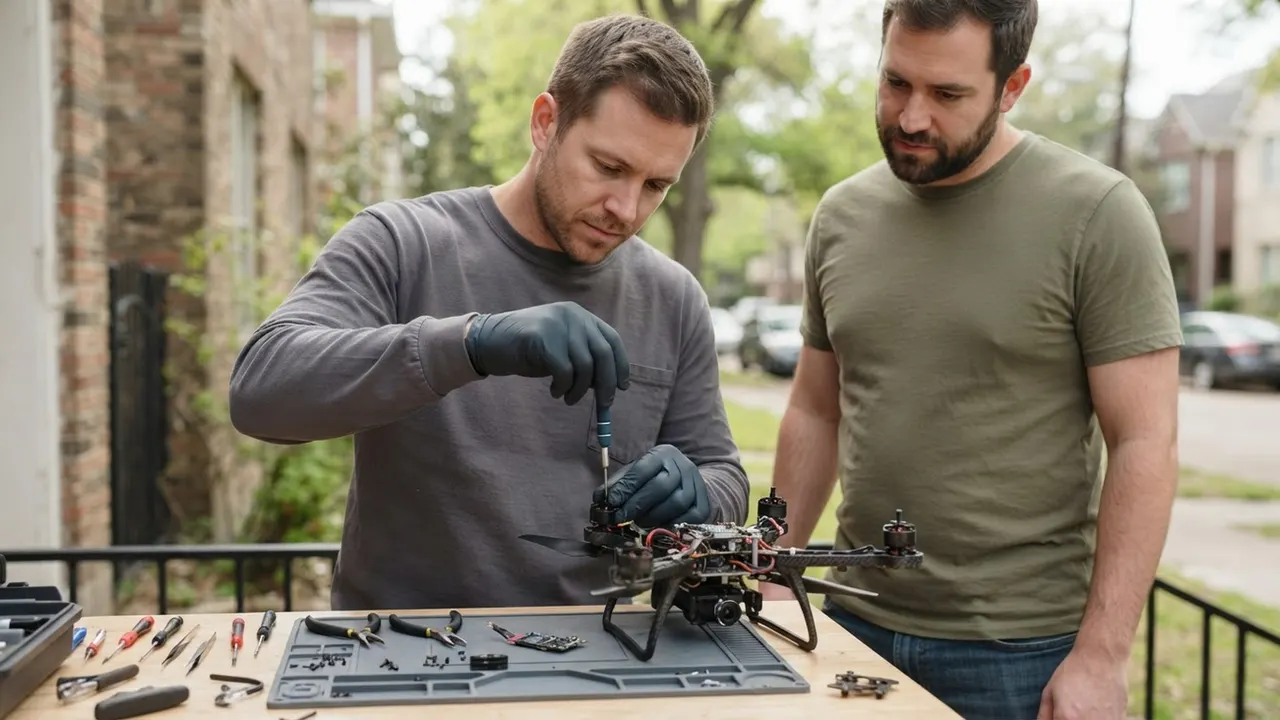 Drone RepairGeneral airframe repair covers the frame, arms, and electronics that carry your payload. If a crash bent the body and killed the gimbal at the same time, we handle both in one visit so you are not paying two diagnostic fees.Explore →
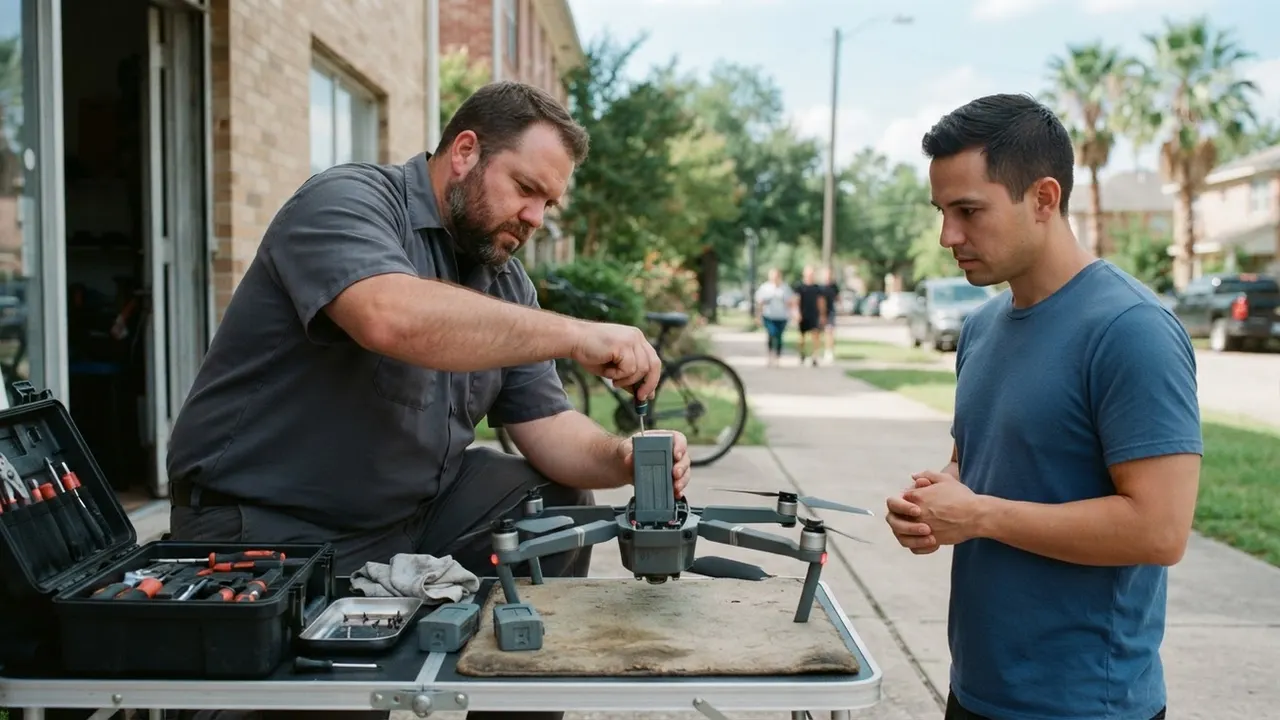 Drone Battery ReplacementSwollen LiPo batteries push voltage sag into the payload bus and can fry sensitive electronics. We test cell balance and internal resistance, then replace packs that are past spec. Fresh batteries protect the payload you just paid to repair.Explore →
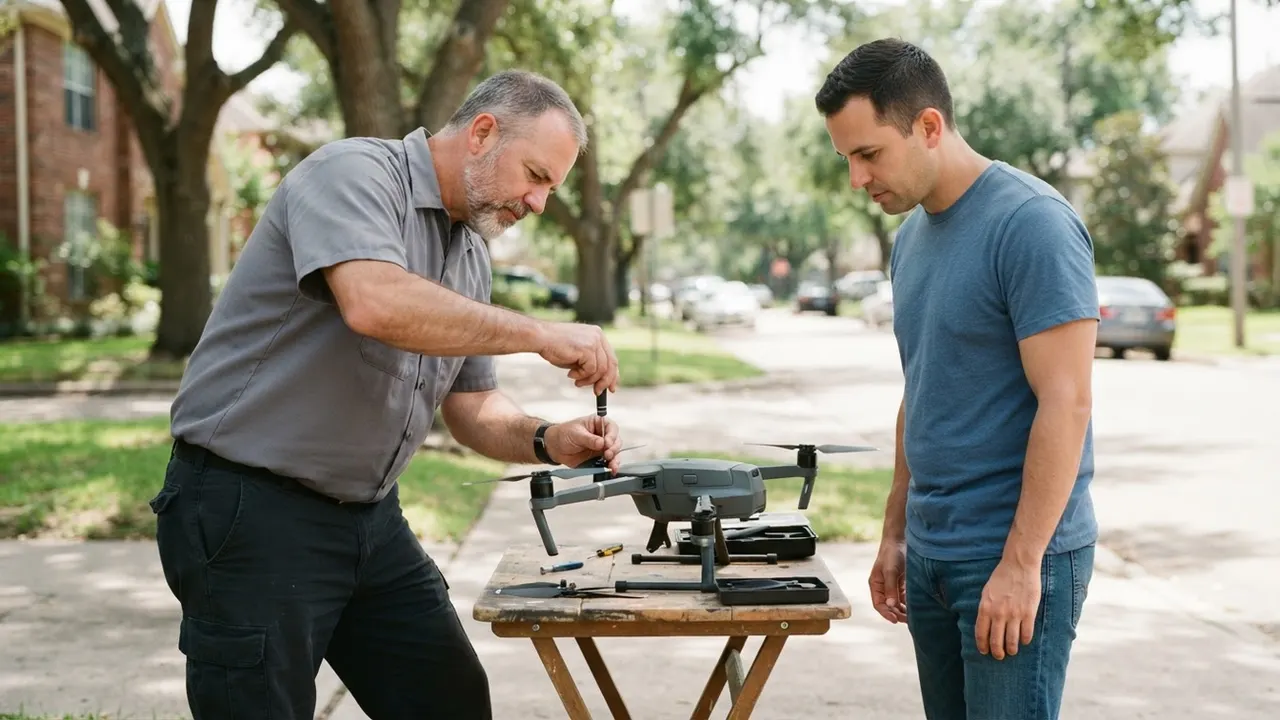 Drone Propeller ReplacementVibration from a chipped or unbalanced propeller wears gimbal motors and blurs camera footage. We balance and replace props as part of payload jobs when the readings show excess vibration, which extends the life of the gimbal assembly.Explore →
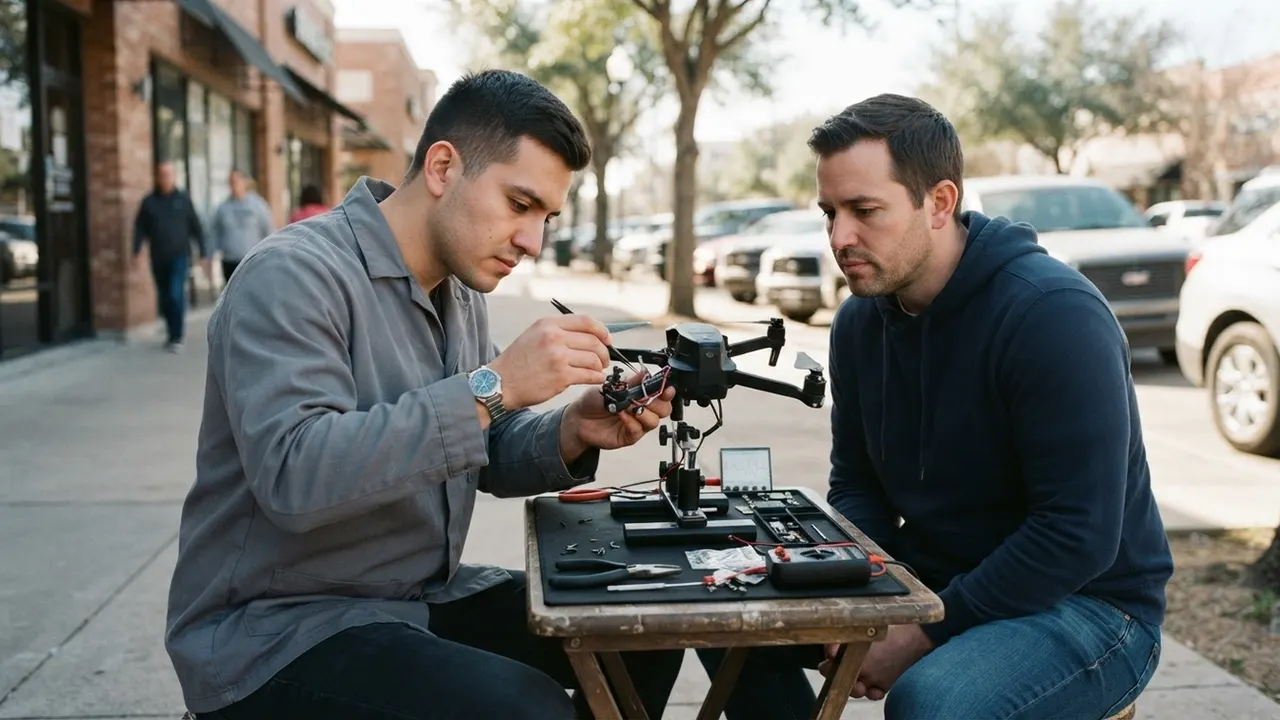 Drone Motor RepairBrushless motor failure causes yaw drift that a gimbal cannot compensate for. We test motor torque and bearing play, then rebuild or replace motors so the airframe flies level and your payload footage stays usable.Explore →
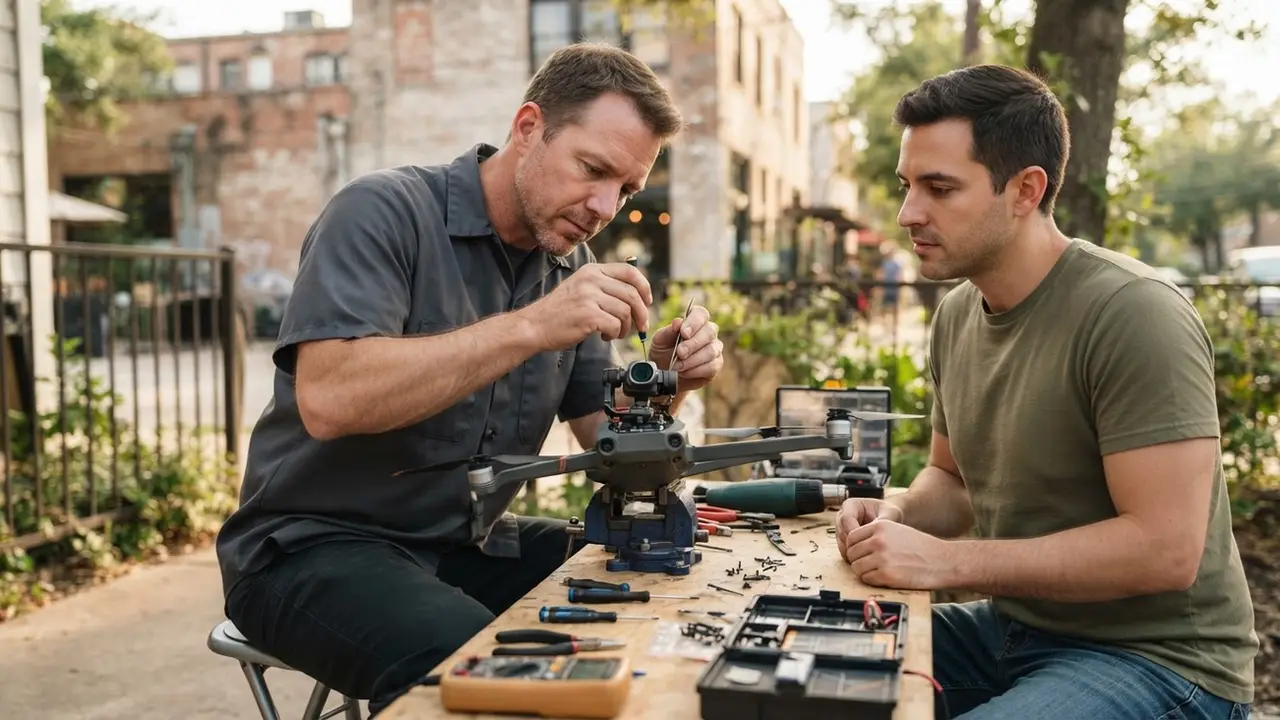 Drone Gimbal RepairGimbal repair is the most common payload job we run. Bent arms, dead roll motors, and torn ribbon cables all land here. We stock gimbal motors and cables for DJI and Autel airframes and recalibrate every axis before the test flight.Explore →
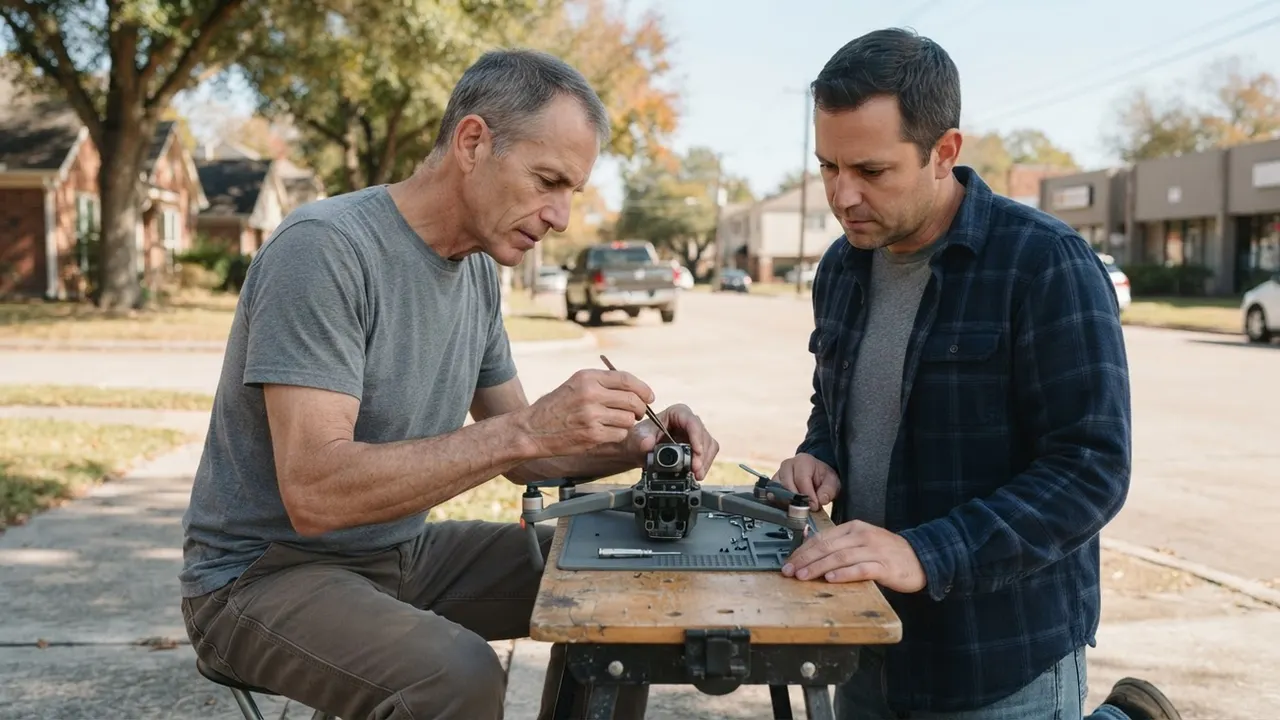 Drone Camera RepairCamera black screens, cracked lenses, and failed image sensors get bench-level attention. We test the live feed, check the ribbon connection, and replace modules when repair is not viable. Thermal and zoom cameras are handled with the same process.Explore →
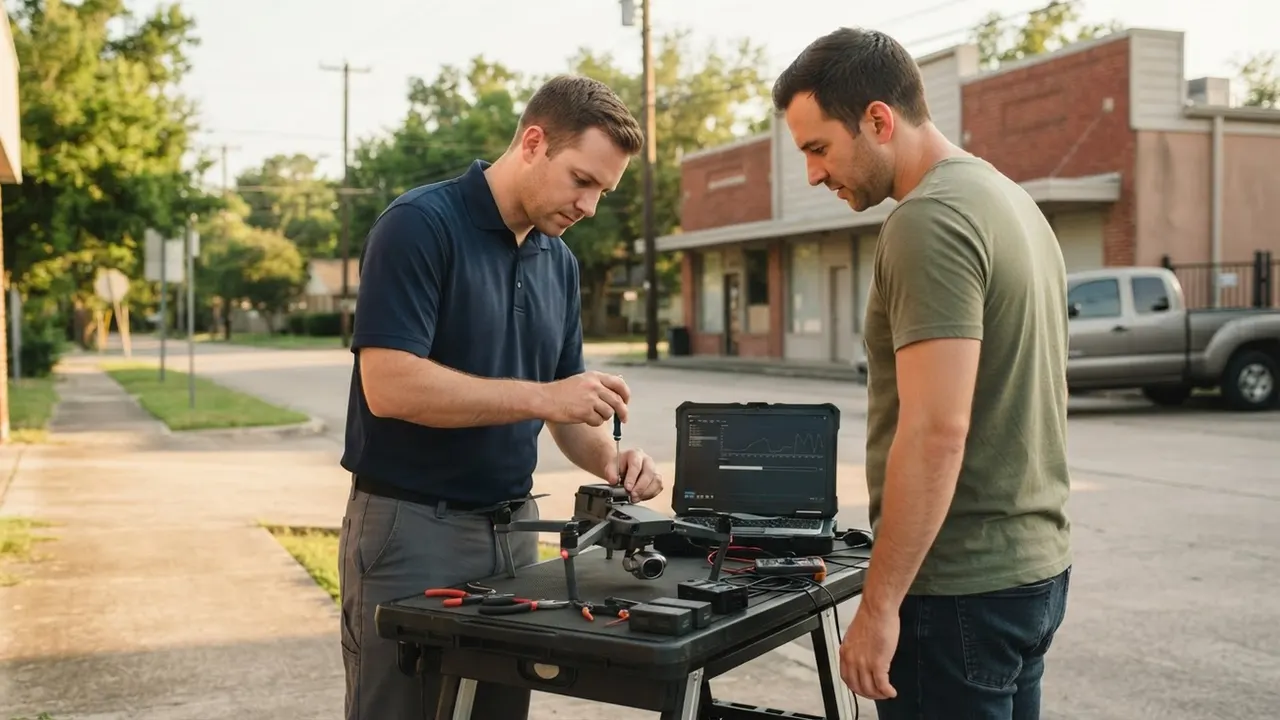 Drone Firmware UpdatesA failed firmware update can brick a payload controller. We flash the correct firmware version, verify sensor handshake, and confirm the gimbal responds to commands. This is often the fix when a payload stops talking to the airframe after an update.Explore →
 Drone Software RepairApp crashes, calibration loops, and sensor errors that survive a firmware flash point to software corruption. We reset the flight controller, reload parameters, and test the payload through the full command set before returning the aircraft.Explore →
Payload down means revenue down. Call our bench, describe the fault, and we will give you a same-day diagnostic window. Workmanship is warrantied and every repair ends with a test flight.
Book a Repair +1 281 555 4468 →Call us at +1 281 555 4468 or stop by the shop. We are open Monday through Friday, 8 a.m. to 6 p.m., and we answer emergency calls 24/7 for commercial operators. Most diagnostics are done the same day you drop off.